Sunday, August 28, 2011

Week Forty Six: Paris Secrets

Paris Secrets by Janelle McCulloch is a guide to the Art and Architecture of the City and its buildings.

Straightforward enough, it discusses the style and eras of exterior and interior design in Paris, my favourite city in the world (so far) but while illustrated lavishly with pictures taken by the author, the text is often repetetive and Janelle obviously struggles with keeping her obvious passion for the city interesting for the reader.

I love Paris and yet I found myself critiquing her style, prose and even photgraphic skills. I think that some pictures were included to pad the length of the book - much like a lot of the text contained.

But some of the background and detail on the styles, the reason why they were that way and where they can be found - were interesting enough to keep me reading.

A good coffee table read, but one you'll be done/irritated/over with quickly.


Sunday, August 21, 2011

Week Forty Five: Whisky


Whisky by Aeneas MacDonald is the classic book on whisky and it's appreciation. Once again a gift book I never got around to finishing, but mostly because I moved house not long after being given it. Another book from the ubiquitous Mr Newby.

And a great choice it is/was. Whisky is informative, witty and reassuring. The instructions for how to imbibe are almost word for word how I was taught and with clear instructions why and how to follow those steps.

The references to the evils of blending, the secrecy and proprietary nature of distillers and the list of distillers - show that little has changed in the over 80 years since it's publicati0n.

A great wee read, makes me want to have a dram.

Where's my Ben Nevis?


Sunday, August 14, 2011

Week Forty Four: We Need To Talk About Kelvin


We Need To Talk About Kelvin (What everyday things tell us about the universe) by Marcus Chown is a science book for the uneducated about science. There are two things wrong with this concept for me.


Firstly I am not uneducated about science, not in my lifetime, certainly not in my year of books - so this was covering a lot of ground I had trod before. One or two new things - like the how the burning age of the sun is calculated, for example. Not much else I didn't already know and therefore not that interested in re-reading (for the nth time).


Secondly it's not that interesting, it gets into too much detail in some places, not enough in others and the authour sounds like one of those uber keen science geeks trying to convince you that what they find exciting you will too - how can you not?


Meh - not bad, just not good.


Next Week is unknown.

Sunday, August 7, 2011

Week Forty Three: Mother Jones

Mother Jones: The Most Dangerous Woman in America by Elliot J Gorn is a biography of Mary Jones (nee Harris) who came to America from Ireland, lost everything and everyone she loved to disease and violence. And then she went into high gear.

Starting very late in life Mother Jones was a force to recokoned with in Labour organisation, anti child labour laws and stood against the right wing nut jobs who took the law in their own hands (literally).

From the age of 60 onwards until her 90's she was a fascinating conundrum of power, success, failure and confusion. I knew of her from the magazine named in her honour, but never in this great detail. The biography is warts and all and is ready to point out her failures and lies, but still treats her with respect and dignity - a fine line in such an interesting and controversial character.

Next Week. Unknown yet. Maybe a book on biblical historical records and maybe 1984.

Saturday, July 30, 2011

Week Forty Two: This Means This, This Means That


This Means This, This Means That - A User's Guide to Semiotics by Sean Hall is a text book of sorts that examines the science or philosophy - or potentially the hidden language of visual representation.

Anything and everything that you can see has a visual representation, otherwise you could not see it. The study of Semiotics breaks this theory down into components for a holistic view of, your view.

The book is straightforward but often asks you a question about you and what you feel/think rather than give you an answer. One item can have many meanings to many people. An object when photographed for instance is still that item, but if the picture is skewed, out of focus or even black and white then the meaning can be wholly different.

Interesting introduction to the subject - I think I want to read more on the subject in greater detail.

Saturday, July 23, 2011

Week Forty One: The Number Mysteries


The Number Mysteries (AKA The Num8er My5teries) by Marcus Du Sautoy takes 5 well known and hitherto unsolved mathematical problems and presents them as challenges for the reader to solve. Not that you are expected to be able, greater minds than the large majority of us have tried so far in vain to solve these. But it's still intriguing enough that in the back of your mind you do start the exercise mentally (until you figure out how much work is involved).

Each of the 5 chapters is presented in readable format - often devolving from the vastly entertaining history and context of the issue down to the impenetrable algebraic representation of the problem in it's simplest (for some) form.

And enjoyable read and it puts some things in context - like how we encrypt Credit Card information on the internet - smart stuff indeed - not just from a concept point of view - but at the sheer scale of the calculations required to decrypt these without the right code keys. I.e. not impossible - but certainly by the time you scratched the surface on one half of the prime key you'd be several years down the track and several code keys on.

Next week: Possibly Orwell, possibly something else.

Saturday, July 16, 2011

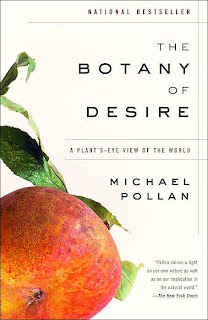
Week Forty: The Botany of Desire


The Botany of Desire by Michael Pollan is at odds with it's stated intention. Ostensibly it's an in depth look at four plants and the desires they engender in humanity (or conversely that we seek in them). But it is also a book about the nature of nature, who drives who and classical studies and greco-roman mythology.

One level is about the four plants, The Apple, Tulip, Marijuana and Potato. And the four histories provide some fascinating insight on the history of and subsequent placement of the four plants in our own history. Learned a whole bunch of stuff. Apples were not routinely eaten for pleasure until approx 100 years ago when advertisers came up with an apple a day etc... prior to this they were mainly a source for booze, not nutrition. The Tulip is descended from the Turkish word for Turban (look at a picture of them both). Marijuana inhibits short term memories the same way the cannabinoids(?) in women's brains prevent them from recalling the specifics of childbirth. Monsanto is evil and messes with potatoes (ok I already knew that).

Another level is the desires and the relationship they have with plants - do plants react to our desires or do our desires reflect the directions the plants drive us in, which comes first - the chicken or the egg. Darwinian ideals drive all these thoughts, but to ascribe them to plants seems silly and counter-intuitive - they have no conscious thought - not in conventional sense - but maybe in a genetic imperative one?

And then each section is bathed in the classic fight of mythology and ancient greco-roman classics, Apollonian order vs Dionysian excess. Marijuana's battle in this arena is particularly captivating as it's effect and purpose is Dionysian but it would not exist and thrive without an Apollonian structure for growth and evolution (through Artificial Selection - not Natural).

Very interesting book and just deep enough to be entertaining while not so massively overdone to bore with too much biological detail.

Next Week: Either 1984, or a book on Math or one of my new Book Depository books on Semiotics or children's literature.